
TENSES:
The word “Tense” means a form of verb that shows time. Here, we will talk about The present simple tense.
While learning a tense we focus on two things:
- Where or in which context we use the tense we are learning.
- The structure of that particular tense.
THE PRESENT SIMPLE TENSE:
The Simple Present Tense is used to talk about:
- A habitual action (I don’t take tea in the breakfast.)
- An action that happens regularly or repeatedly. (I take five classes in a day.)
- Universal truth. (The sun rises in the East.)
- An action that will happen in future. (The train leaves at 5 PM tomorrow.)
Understanding the Present Simple Tense
Key Features of the Present Simple Tense
Understanding the present simple tense:
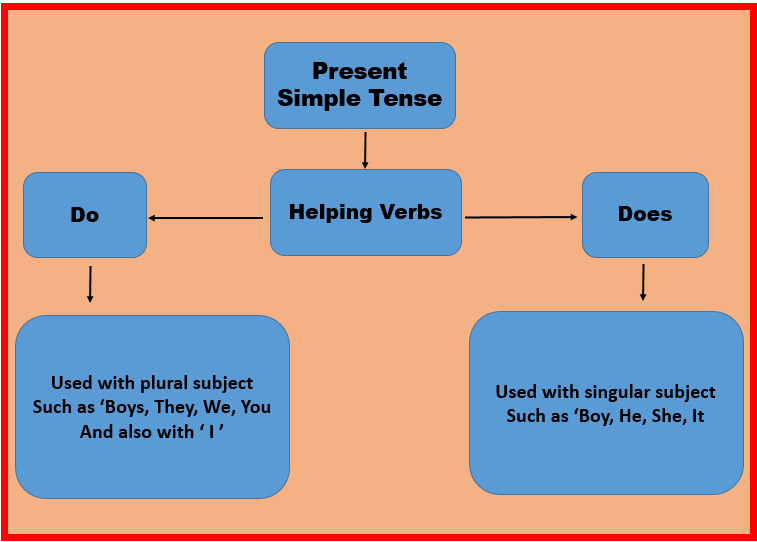
Helping Verbs of the Simple Present Tense: Do and Does
(Point to remember:
In the Simple Present Tense, we use “DO” and “DOES” as helping verbs. We use “DO” with singular subject as He, She, It or Aslam whereas “DOES” is used with plural subject such as we, you, they, boys or Aslam and Akram. Pronoun ‘I’ is also a singular subject but it takes ‘Do’ not ‘Does’)
Main verb of the Simple Present Tense:
Present forms of main verb are used in this tense. It can be Present General form or Present Third-person Singular form such as Play (Present General form) and Plays (Present Third-person Singular form)
STRUCTURE OF THE SENTENCE THE SIMPLE PRESENT:
POSITIVE SENTENCE OF THE SENTENCE THE SIMPLE PRESENT:
SUBJECT + PRESENT FORM OF M.V + OTHER WORDS
Ex. Asad writes everything beautifully. (No helping verb in positive sentence.)
We visit our grandparents every weekend.
(Point to remember:
In the positive sentence of the Simple Present Tense, A singular subject takes a singular verb and a plural subject takes plural verb i.e. “Asad” is singular subject and “We” is a plural subject and “writes” is singular verb while “visit” is plural verb. A singular verb ends with s/es such as writes, teaches, goes, looks, wants, visits etc.)
NEGATIVE SENTENCE OF THE SENTENCE THE SIMPLE PRESENT:
SYBJECT + DO/DOES+NOT+ PRESENT FORM OF M.V + OTHER WORDS.
EX. Our English teacher does not take English class regularly.
(Helping verb Does is used with singular subject while Do with plural subject.)
INETERROGATIVE SENTENCE OF THE SENTENCE THE SIMPLE PRESENT:
DO/DOES + SUBJECT + PRESENT FORM OF M.V + OTHER WORDS +?
EX. Do they cook the meal?
(Remember that in the Simple Present Tense, we use Do/Does as helping verbs and after these helping verbs, present general form (plural form) of main verb is used in the sentence. Singular form of main verb cannot be used with the helping verbs Do/Does.)
Dear students, till now you have learned about the active structure of the present simple tense but there is a passive structure of the present simple tense that is a bit different.
If we talk about the passive sentences of the above mentioned tense so it would not be wrong to say that we have to use ‘Is, Am, Are as helping verbs instead of ‘Do and Does‘ and past participle of the main verb.
For example:
“Sam does not teach English on Sunday.” The sentence is in active structure and the passive of this would be: “English is not taught by Sam on Sunday.”
The above examples show that we don’t use Do and Does in passive voice nor we use the present form of verb.
The three helping verbs of passive structure (is,am,are) are used in the following way:
Helping verb Is: It’s used with singular subject such as: He is given a gift by his friend.
Helping verb Am: It’s used only with pronoun ‘ I ‘ such as: I am given a gift by my friend.
Helping verb Are: It’s used with plural subject such as: Boys are taught English by Sam.