
Introduction to the Poem: The poem “The Daffodils” has been written by William Wordsworth. He is known as the Poet of Nature because his poems often deal with the beauty of nature. This post serves as a Paraphrase of the poem The Daffodils.
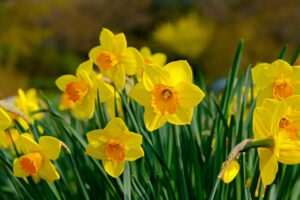
Paraphrase:
Stanza 1:
I wandered lonely as a cloud,
That floats on high o’er vales and hills,
When all at sudden I saw a crowd,
A host of golden daffodils;
Beside the lake, beneath the trees,
fluttering and dancing in the breeze.
Paraphrasing:
Once I wandered over valleys as lonely as cloud. I saw a number of golden daffodils along the bank of a lake under trees. They were fluttering and dancing in the cold wind of the morning.
The imagery of a solitary wanderer evokes a sense of peace and reflection. As the speaker likens themselves to a cloud, it presents a metaphor for freedom and detachment, suggesting a longing for introspection. The sight of the daffodils serves as a catalyst for joy, showcasing how nature can uplift the human spirit. This section not only summarizes the stanzas but also invites the reader to consider their own experiences in nature and the emotions it evokes.
Stanza 2:
Continuous as the stars that shine
And twinkle on the milky way,
They stretched in never ending line,
Along the margin of the bay,
Ten thousand saw I at a glance,
Tossing their heads in sprightly dance.
Paraphrasing:
The daffodils appeared to be as continuous as the twinkling stars on the milky way. They stretched in a line along the bank of the adjacent bay as for as I could see. It seemed as if I saw ten thousand of them at a glance that were dancing in great delight.
Wordsworth’s comparison of daffodils to stars highlights the abundance and beauty of nature. The phrase ‘ten thousand’ suggests a limitless quantity, emphasizing that nature’s beauty is vast and overwhelming. This abundance can relate to the feelings of happiness and wonder that one experiences when surrounded by such beauty. Readers are encouraged to reflect on their connections with similar landscapes and the emotional responses they elicit.
Stanza 3:
The waves beside them danced; but they
Out-did the sparkling waves in glee:
A poet could not but be gay,
In such a jocund company:
I gazed-and-gazed but little thought
What wealth the show to mw had brought.
Paraphrasing:
The waves on the surface of the lake danced as the cold morning wind passed them. But the daffodils danced with a greater joy. A poet can feel nothing but happiness in the company of such beautiful flowers. I looked at the beautiful flowers for a long time. While I was there, I didn’t understand the real value of that beautiful scene.
The poet’s acknowledgment of the waves and their dance serves as an important contrast to the daffodils. While the waves are animated by the wind, the daffodils exhibit a joyful dance that surpasses the waves’ delight. This interaction speaks to the theme of how nature’s elements can inspire creativity and happiness. In this light, the imagery evokes an appreciation for the beauty found in simple moments of nature.
Stanza 4:
For oft, when on my couch I lie,
In vacant or in pensive mood,
They flash upon that inward eye,
Which is the bliss of solitude;
And then my heart with pleasure fills,
And dances with the Daffodils.
Paraphrasing:
Whenever I lie on my bed whether in a happy or sad mood, I suddenly remember the beautiful daffodils. My heart fills with joy and it seems to me as if my heart is dancing with the daffodils.
In the final stanza, the speaker reflects on the lasting impact of the daffodils in their memory. The phrase ‘the bliss of solitude’ underscores the importance of moments of quiet reflection. It suggests that the experiences we cherish in nature contribute to our well-being, offering us solace in times of solitude. This connection between inner peace and nature serves as a reminder of the healing power that the natural world holds.